Sacred Journeys · 21 July 2026 · 5 min read
What Happens When You Travel with Intention? Sacred India vs Regular Tourism
Two people can visit the exact same Tamil Nadu temple during Navaratri. One leaves with 40 photos. The other leaves with a shifted nervous system. Here's the actual psychology and practice behind the difference — not just the aesthetic of it.
by Boundless U
A Concrete Example, Not Just a Concept
Picture two travelers arriving at the Meenakshi Amman Temple in Madurai on the same morning, during the same Navaratri festival week.
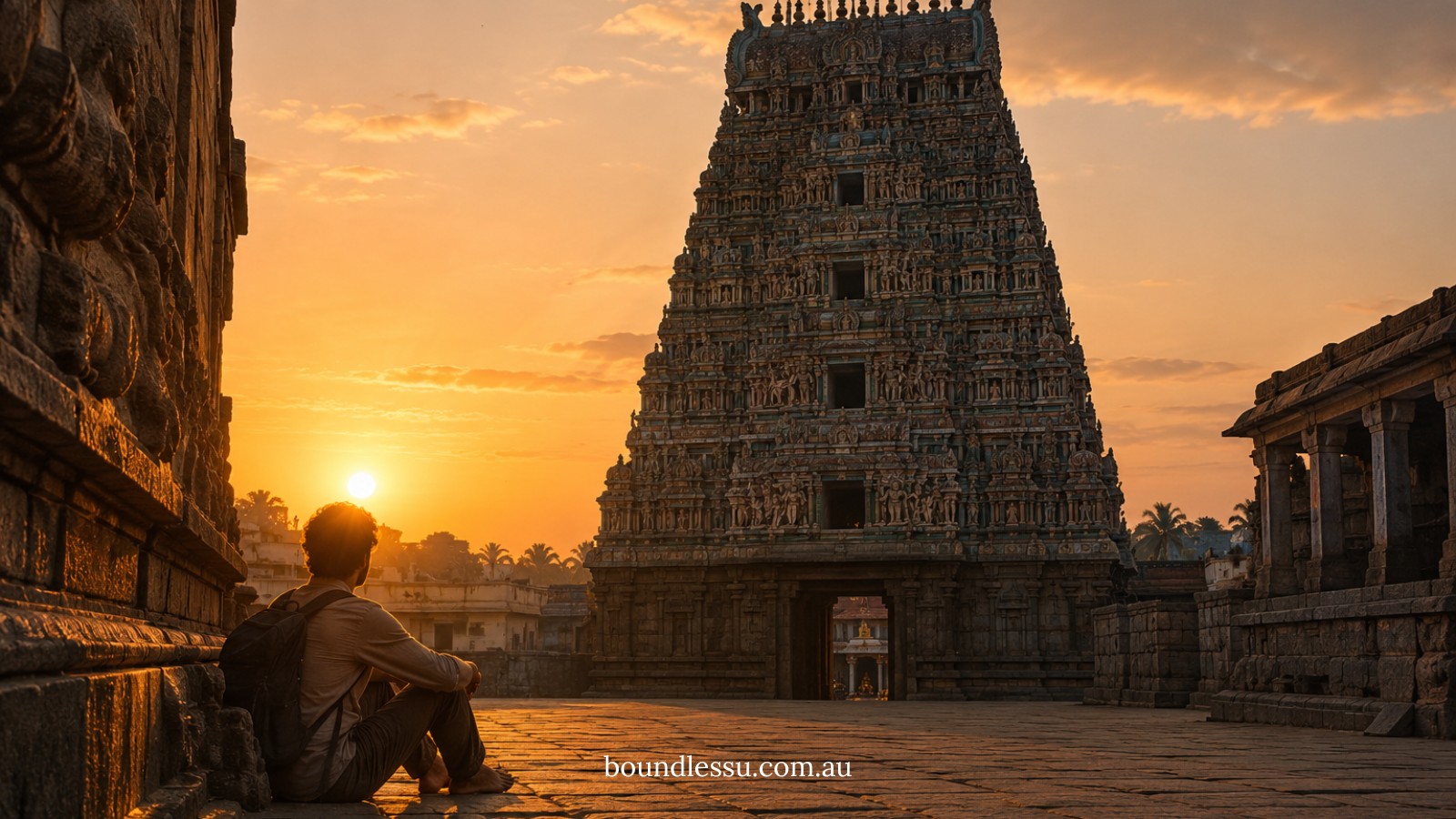
Traveler A has 45 minutes before the next stop on a group itinerary. They walk the outer corridor, photograph the gopuram (the temple's towering gateway, some reaching 170 feet, covered in thousands of carved deities), buy a souvenir, and leave. By dinner, the temple is one blurred stop among six that day.
Traveler B arrives an hour before sunrise, during Brahma Muhurta — the pre-dawn window Vedic tradition considers most conducive to clarity, roughly 96 minutes before sunrise. They sit in the corridor as the first priests begin the day's rituals, stay through a single darshan (the ritual viewing of the deity), and leave three hours later having spoken to no one and photographed nothing.
Same coordinates. Same festival. Radically different trip. The difference isn't spiritual sensitivity or luck — it's structural. Traveler B built the conditions for a different kind of experience; Traveler A didn't.
The Actual Psychology Behind Why This Works
This isn't just an aesthetic preference for "slow travel." There's real research explaining why intentional travel produces different effects than conventional tourism.
- Awe research: psychologist Dacher Keltner's research at UC Berkeley found that experiences of awe — triggered reliably by vast natural or architectural scale, like a 170-foot gopuram or a mountain temple — measurably shrink self-focus and increase prosocial behaviour, at least temporarily. Tourism rarely creates the stillness needed for awe to register; it's usually moving too fast toward the next stop.
- The peak-end rule: Nobel laureate Daniel Kahneman's research shows we remember experiences based on their most intense moment and how they ended, not their average quality. A rushed, checklist-style trip has no single peak — it's uniform, forgettable motion. A single, uninterrupted hour of stillness creates a peak the mind actually encodes.
- Liminality: anthropologist Victor Turner used this term to describe the transitional, in-between state at the heart of ritual and pilgrimage — no longer who you were, not yet who you'll become. Turner argued this state is precisely what makes pilgrimage transformative, and it requires enough unstructured time to actually take hold. A packed itinerary leaves no room for liminality to develop.
A Real Comparison: Same Day, Two Itineraries
Regular tourism itinerary (typical South India day tour):
- 8:00am — Hotel pickup, bus to first temple
- 9:00–9:45am — Temple visit, guided walkthrough, photos
- 10:00am–12:00pm — Second site, market stop, lunch
- 1:00–4:00pm — Two more stops, souvenir shopping
- Evening — Return to hotel, review photos, plan tomorrow
Intentional travel itinerary (same destination, restructured):
- 5:30am — Arrive before sunrise, sit through Brahma Muhurta
- 6:30–9:30am — Remain through a single ritual cycle, no photography, no talking
- 10:00am — Walk to a nearby tank or river (many South Indian temples are built beside one) and journal for 20 minutes
- Midday — Rest. Deliberately unscheduled.
- Late afternoon — One conversation with a local priest, guide, or fellow traveler about what came up that morning
Same location, same day, same budget in most cases. The second version simply removes the pressure to cover ground and replaces it with the specific conditions awe and liminality research says are needed.
Why South India Specifically Rewards This Approach
This isn't a generic "sacred travel" claim — South India has structural features that make intentional travel unusually effective there:
- Temple architecture is directional and sequential by design. Dravidian temples are typically built with a series of concentric walls (prakarams) leading inward to the sanctum (garbhagriha), meaning the physical act of walking inward mirrors a contemplative narrowing of attention — it's built into the architecture, not imposed on it afterward.
- Navaratri itself is structured around nine nights, each traditionally associated with a different aspect of the Divine Feminine (Durga, Lakshmi, and Saraswati across three sets of three nights) — giving the festival an inherent narrative arc that rewards multi-day presence rather than a single rushed visit.
- The Siddha tradition of Tamil Nadu specifically emphasises direct, embodied practice over passive belief — sites associated with Siddhas like Thirumoolar are traditionally understood as places to practice, not just observe, reinforcing that presence (not photography) is the point.
Three Questions to Ask Before Any Trip
You don't need South India specifically to apply this. Before your next trip, sacred or otherwise, ask:
- What is the one experience I most want to have room for? (Not a list — one.) Build the day around protecting time for that, and treat everything else as optional.
- Where is the unstructured time? If every hour has a plan, there's no space for liminality to do its work. Deliberately leave at least one multi-hour block empty each day.
- What am I willing to skip? Intentional travel usually means seeing fewer things. Decide in advance what you're comfortable missing, so you're not negotiating it in the moment out of guilt.
What to Actually Do Differently, Practically
- Digital sunset: put the phone away by a set time each evening of the trip — even 6pm to 6am removes both photography pressure and the temptation to narrate the day to people back home in real time.
- One journal prompt, same one, every day: "What did I notice today that I would have missed if I were rushing?" Consistency across days makes shifts visible that a single entry won't show.
- Arrive before opening hours at least once. Whether it's a temple, a market, or a natural site, arriving before the crowds changes the sensory experience entirely — quieter, slower, and closer to how the space was originally used.
The Honest Limits of This
It would be dishonest to promise that restructuring an itinerary guarantees transformation. Awe research shows measurable but often short-lived effects. Liminality, per Turner's own work, requires genuine reintegration afterward to produce lasting change — the trip itself is only half the process.
A single intentional day won't undo months of burnout, and a single rushed trip won't erase years of practice. The claim here isn't magic. It's that the structural conditions matter, and most modern travel accidentally removes exactly the conditions that make any of this possible in the first place.
Why This Matters More Than Ever
Modern life is unusually good at keeping people busy and unusually bad at giving them space to process anything. Travel has always offered a rare exception — a genuine interruption to routine. But if that interruption is filled with the same pace, noise, and consumption as ordinary life, the opportunity mostly gets missed.
Intentional travel is simply travel that doesn't waste that rare interruption — built on real psychological mechanisms, not just a nicer aesthetic.
If something in this resonates — that pull toward a slower, deeper kind of travel — it's worth paying attention to.
Boundless U explores the meeting point of Vedic & Siddha wisdom, NLP, and quantum physics. Follow along each week for teachings, reflections, and sacred community.